

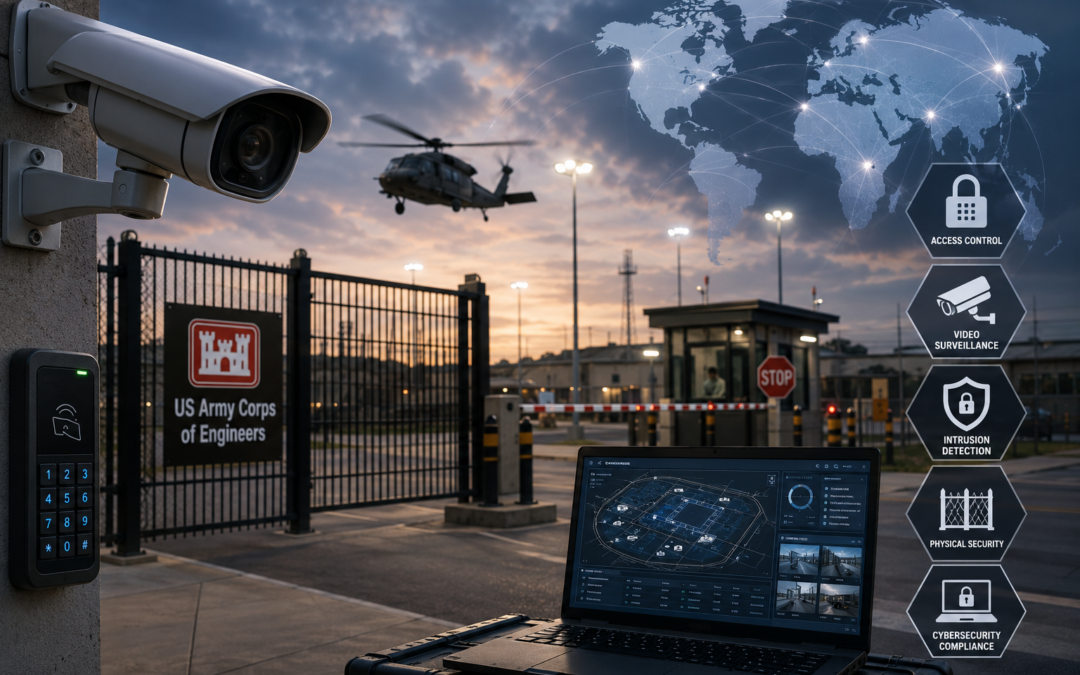
The U.S. Army Corps of Engineers Huntsville Engineering and Support Center (CEHNC) is preparing ESS VIII, which is the eighth generation of its Electronic Security Systems Multiple Award Task Order Contract with a $2.5 billion ceiling. The solicitation is expected in Q4 FY2026 and will be structured as a partial small business set-aside alongside an unrestricted pool. This structure provides dedicated access for smaller firms alongside the large defense and security integrators that have historically dominated this vehicle.
CEHNC’s ESS program is the Army’s Mandatory Center of Expertise for electronic security systems worldwide, supporting DoD installations and other federal agencies across CONUS and OCONUS locations that reside in more than 30 countries, including: Germany, Japan, South Korea, Kuwait, and the UAE.
The SF330 submission format (typically associated with Architect and Engineering acquisitions) signals that CEHNC will evaluate firms on technical qualifications and past performance before any pricing, which means the pre-solicitation period is the right time to build a team, document relevant experience, and establish relationships with the program office.
OPPORTUNITY SNAPSHOT
- Opportunity: Electronic Security Systems VIII (ESS VIII)
- Agency: U.S. Army Corps of Engineers
- Estimated Value: $2.5B
- Type: Multiple Award Task Order Contract (MATOC)
- Expected Solicitation: Q4 FY2026
- SF330s Due: Q1 FY2027
- Expected Award: Q2 FY2028
- Contract Type: IDIQ, Firm-Fixed-Price task orders
- Duration: 36-month base + 2 × 24-month options (approximately 7 years)
- Competition: Partial Small Business Set-Aside
- NAICS: 541512 – Computer Systems Design Services ($34M size standard)
- Place of Performance: CONUS and OCONUS (30+ countries)
- Security: Secret clearance required for all key personnel; higher clearances required for select task orders
WHY ESS VIII MATTERS
CEHNC’s ESS program is the Army’s Mandatory Center of Expertise for electronic security systems worldwide, supporting DoD installations across CONUS and more than 30 OCONUS countries. Task orders go well beyond installation and require site surveys, technical data package development, cybersecurity compliance (with full RMF support and Authority to Operate), and long-term sustainment, often in classified and operationally active environments.
Firms that can integrate electronic security engineering with DoD cybersecurity requirements are meaningfully better positioned than those that can only support installation capability.
The partial small business set-aside structure is the most important variable still to be defined. ESS VII competed primarily full and open, with a mix of large primes and small business awardees. If ESS VIII dedicates a meaningful portion of awards to a dedicated small business pool, it would represent a real shift in how CEHNC distributes work. Small businesses that build competitive teams and document the right past performance will be best positioned to compete for those slots.
WHO SHOULD CONSIDER ESS VIII
ESS VIII is designed for firms with experience procuring, installing, and maintaining electronic security systems at DoD or federal installations. Given the partial small business set-aside structure, small businesses with the following capabilities should assess their fit now:
- Electronic access control and intrusion detection system installation and integration
- Video surveillance and CCTV systems
- Data transmission systems and command and control integration
- Physical security measures — fencing, barriers, lighting, hardening
- DoD cybersecurity compliance — RMF, eMASS, STIG implementation, ATO support
- OCONUS project experience, particularly at DoD installations abroad
- Secret facility clearance and cleared technical personnel
Key personnel requirements at the base contract level include a Program Manager (10+ years ESS experience, PMP preferred), Senior Electronic Security Engineer (10+ years, PE or CPP preferred), Senior Contracts Manager, and Quality Control Manager. These positions require a Secret clearance with the potential based on task orders to obtain higher clearances.
HOW OST CAN HELP
With the solicitation roughly 4–6 months out and SF330s due soon after, beginning pre-solicitation activities now, such as competitive positioning assessments, strengthens PWin. OST supports firms pursuing complex CEHNC and USACE multi-award contracts with:
- Bid/no-bid assessment: Evaluating your technical capabilities, clearance posture, key personnel qualifications, and past performance alignment against ESS VIII requirements
- Capture planning: Developing win themes and positioning relative to the 22 ESS VII incumbents across both the small business and unrestricted pools
- Teaming strategy: Identifying complementary partners to strengthen technical coverage across ESS subsystems, geographic reach, and cybersecurity capabilities
- SF330 preparation: Organizing relevant project examples, key personnel resumes, and technical narratives in the format CEHNC will evaluate
- Past performance strategy: Documenting electronic security, physical security, and cybersecurity experience from federal, DoD, or commercial programs.
If you are evaluating whether USACE’s CEHNC ESS VIII opportunity aligns with your firm’s capabilities or need support with your proposal delivery, we are happy to help you determine if you can benefit from this $2.5B solicitation. If this interests you, please book a call with OST Partner and President Bill Schalik via the button below.


