
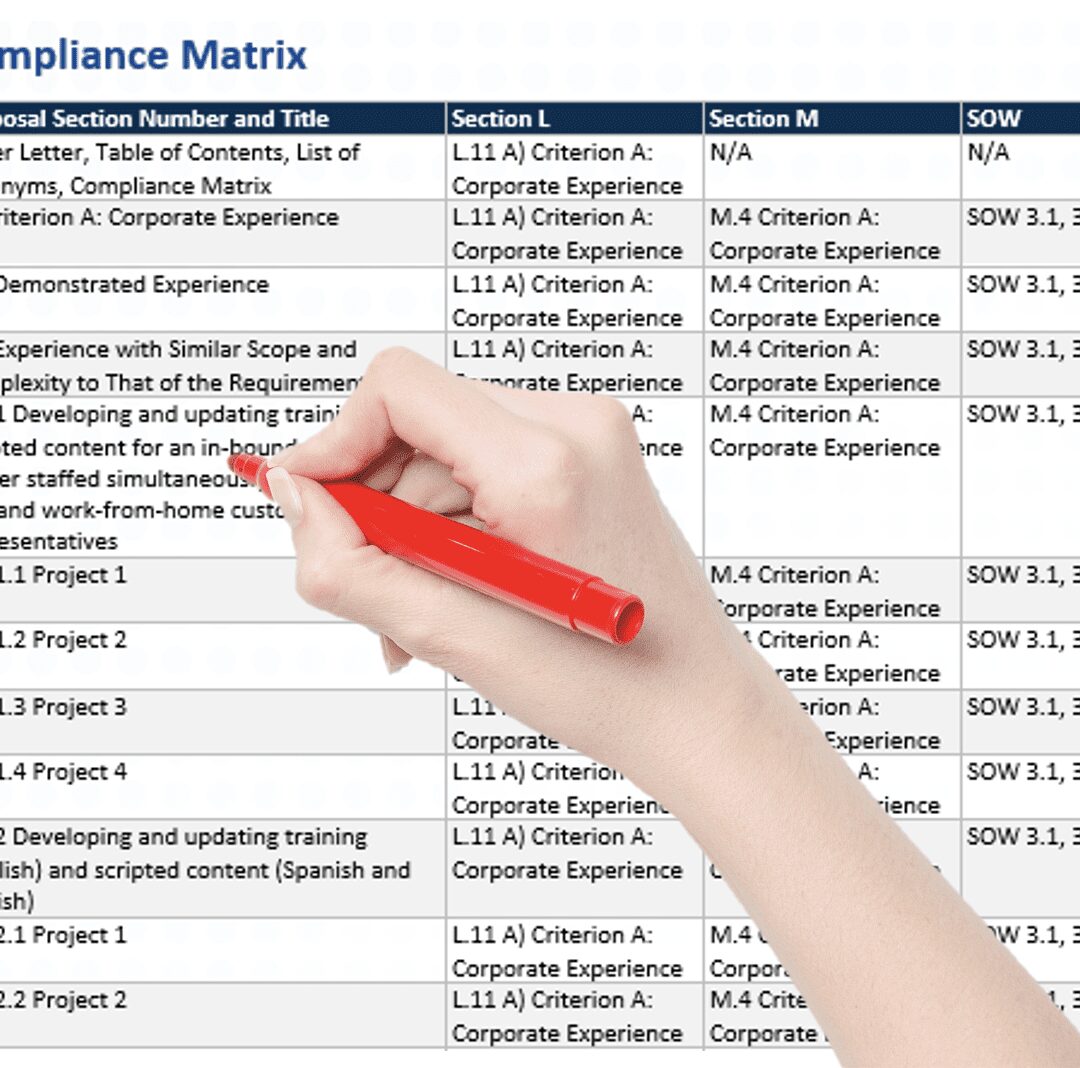
Government proposals and compliance go together like sushi and rice – one can hardly exist without the other. A compliance matrix is a crucial tool to make sure that your submission is compliant. It helps proposal managers and evaluators make sure that all the materials made their way into the proposal how they were supposed to.
However, there is more than one way to develop a compliance matrix, and different matrixes have different uses. Additionally, the terms for different types of matrixes are used interchangeably. Is the compliance matrix the same as the cross-reference matrix? What about a compliance checklist? What about a compliance matrix that doubles as a proposal assignments matrix, that also doubles as a proposal status tracking matrix? How are they different from an RFP “shred?”
A classic proposal compliance matrix is a sequential index of all requirements correlated to your proposal. It lists each proposal requirement (Section L), with the corresponding proposal section number, title, and page number where it appears. Then, the matrix lists all the evaluation criteria (Section M), one after the other. It then does the same for the statement of work. This type of compliance matrix goes on for pages and is uncommon in page-limited proposals.
A more detailed variation of the proposal compliance matrix is the Request for Proposal (RFP) “shred.” In this version, each requirement sentence is copied to the matrix together with its numerical reference to the RFP. Each requirement is correlated to the proposal section, section number, title, and page number. This type of matrix is convenient for the evaluator, as they don’t have to read the RFP or reference anything, the requirements are right in front of them. It may backfire, however, if you have not been 100% thorough with the compliance. Often the compliance matrix is there to create an impression of thoroughness, even if you had to fudge how you addressed the requirements in some areas due to lack of subject matter knowledge or past experience.
A cross-reference matrix crosswalks the proposal sections to the corresponding instructions, evaluation criteria, statement of work, and other requirements, and it provides the relevant proposal page. A cross-reference matrix is used in page-limited proposals and may be required by the customer. It shows how the RFP requirements “intersect,” and stitch together elements found throughout the RFP.
A proposal compliance checklist is a “shredded” or parsed RFP. It has every single requirement sentence by sentence in a table, with requirements words (such as “shall,” “must,” and “require”) highlighted. It also has a column for a corresponding proposal section where the requirement is addressed, and a column to check yes or no for compliant or not. This is an internal document to use during proposal color reviews.
The most useful type of proposal compliance matrix is a cross-reference matrix that serves multiple functions. This matrix contains a proposal outline accompanied by proposal assignments, a punch list of actions for each section, and visual status for a well-organized proposal effort. This tool is vital to continuous situational awareness and progress tracking in your proposal. At OST, we use it at daily proposal status meetings and update it after each color review.
The point of a proposal compliance matrix is not to create an administrative burden but to serve as a critical tool that ensures you don’t skip sections or cut corners with your proposal.
Learn how to build a compliance matrix and get a proposal compliance matrix template here.
Upcoming Bid & Proposal Academy Classes
Events
-
-

Webinar: Turning Customer Insights Into Win Strategy
Contracts are still won the old-fashioned way: through human relationships and hard-earned customer intelligence during capture. The problem generally isn’t getting the intel — it’s what happens next. Too often, […]
-
-
Winning Government Cost Proposals Including AI Essentials
OST Global Solutions Virtual Classroom MD, United StatesDeveloping a Winning Cost Volume course helps increase federal contract win probability by strengthening cost proposal development skills. Updated for 2026, this course incorporates AI-assisted tools to support pricing analysis, cost modeling, and documentation efficiency. The course covers Government contract evaluation, pricing fundamentals such as cost buildup and cost volume elements, price strategy, Basis of Estimate development, assumptions, Work Breakdown Structure creation, cost volume narratives, and strategies for winning lowest price technically acceptable proposals, while demonstrating how AI can be used responsibly to improve accuracy, consistency, and proposal readiness.
-
Proposal Graphics Conceptualization & Design Including AI Essentials
OST Global Solutions Virtual Classroom MD, United StatesThis course provides the skills necessary to conceptualize proposal graphics that clearly convey a winning solution to Government customers. Updated for 2026, the course includes the use of AI-assisted tools to enhance idea generation, visual storytelling, and graphic refinement. Participants will learn how to brainstorm strong graphic concepts, create effective action captions, sketch and structure visuals, and apply professional design principles while responsibly leveraging AI to improve clarity, consistency, and efficiency in proposal graphics.


